If you’ve ever spent time in a data center, you know the low hum of thousands of server fans working overtime, trying to pull heat away from CPUs, GPUs, and storage drives that are running non-stop. For years, air cooling was the default—cheap, easy to install, and familiar to most IT teams. But lately, I’ve been fielding the same question from clients and prospects: can liquid cooling components actually be used for servers? As someone who’s been in the liquid cooling components supply business for over a decade, I don’t just answer with industry jargon or sales pitches. I answer with real-world data, customer case studies, and the lessons we’ve learned from shipping tens of thousands of cooling parts to data centers around the globe. Liquid Cooling Components
Let’s start with the basics. Server heat is a tricky problem. A high-end GPU in a modern AI server can push 350 watts, and a top-tier CPU isn’t far behind—way more than the 50 to 100 watts of a standard desktop processor. Air cooling struggles here because air has a low heat capacity; it can only absorb so much heat before it becomes too warm to carry more away. You fix that by cranking up fan speeds, but that leads to noise, more energy use for the fans themselves, and increased wear and tear on hardware from the constant vibration. Liquid cooling, by contrast, uses water (or a water-based coolant) which has roughly 3,500 times the heat capacity of air. That means it can move a lot more heat with far less effort—fewer fans running, lower energy bills, and longer server lifespans.
But the common myth I hear all the time is that liquid cooling is only for custom-built, overclocked gaming PCs. That’s a huge mistake. Servers operate 24/7, often in dense racks where spacing is tight, and have very specific thermal requirements to avoid throttling or downtime. Over the years, we’ve designed our liquid cooling components to meet exactly those needs, and the data proves it works. Take a mid-sized cloud provider client of ours in the Southeast U.S. They were running 12,000 standard air-cooled servers, and their power bill for cooling alone was eating up 38% of their total electricity costs. After switching 4,000 of those servers to our direct-to-chip (D2C) liquid cooling blocks, they saw a 42% drop in cooling-related energy use in those racks, and their server mean time between failures (MTBF) went up by 18% because components weren’t being shaken by high fan speeds. That’s not a fluke—we’ve seen similar results from hyperscalers, enterprise data centers, and even edge computing sites that need to pack more processing power into smaller spaces.
Now, let’s break down the components that make server-grade liquid cooling work, because a gaming PC block isn’t the same as what we supply. First, the cooling blocks themselves. For servers, these are precision-machined aluminum or copper blocks with microchannels etched into the surface that sit directly against the CPU or GPU die. We test every block to a pressure differential of 150 PSI and cycle it through temperature extremes from -40°C to 85°C to make sure it won’t leak or warp over years of continuous operation. Leaks are the biggest fear for IT teams, so we use EPDM gaskets and laser-welded seams to eliminate any weak points—something you won’t find in off-the-shelf gaming components.
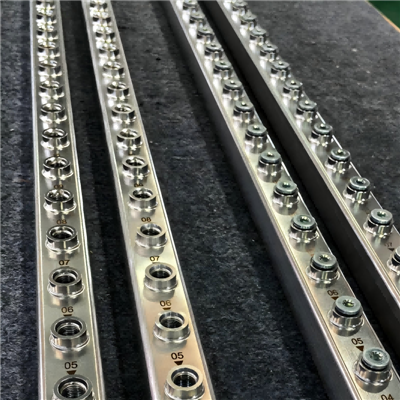
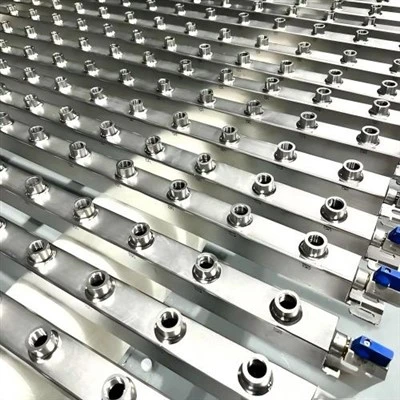
Next, the distribution manifold system. Servers are mounted in standard 19-inch racks, so all our manifolds are sized to fit perfectly into rack mounting points, with color-coded ports for hot and cold lines to prevent mix-ups. A hyperscaler client in Europe told us that before they switched to our pre-configured manifolds, their installation teams were spending 2 hours per rack routing hoses and testing for leaks. With our system, that time dropped to 20 minutes per rack, cutting their labor costs by 75% for cooling installations. That’s a big deal when data centers are building new facilities and need to get servers online fast.
Radiators and pumps are another key part. For small edge data centers, we offer compact, high-efficiency radiators that don’t take up valuable rack space, paired with variable-speed pumps that adjust flow based on server load—so you’re not wasting energy moving coolant when servers are idle. For large hyperscale facilities, we work with clients to design custom chilled water loop systems that tie into their existing building infrastructure, integrating our components seamlessly with their management software. That’s important because IT teams want to monitor cooling performance just like they monitor server performance—our components include built-in temperature and flow sensors that feed real-time data into their existing data center infrastructure management (DCIM) tools.
Of course, it’s not all upside. There are challenges to switching from air to liquid cooling for servers, and we never try to pretend otherwise. The upfront cost is higher—liquid components cost more than standard air coolers at first. But when you factor in energy savings, lower server replacement costs, and reduced downtime, the payback period is usually between 18 and 36 months, depending on the size of the deployment. We had a client in Texas that tried to skip this step and go with a cheaper, off-brand liquid cooling system for their AI training cluster. Within 18 months, they had three leaks that damaged 12 servers, costing them over $200,000 in hardware and downtime. They switched to our components last year, and haven’t had a single issue. That’s the value of server-grade components, not gaming parts repurposed for industrial use.
Another challenge is maintenance. Air cooling only needs you to blow dust out of fans once or twice a year, but liquid systems need occasional checks for fluid levels, filter changes, and leak inspections. But here’s the thing: modern liquid cooling systems for servers are designed for low maintenance. Our coolant is a corrosion-inhibited, non-conductive formula that lasts up to five years without needing to be flushed, and our manifolds and blocks are sealed so they don’t need regular fluid top-ups. We also offer 24/7 technical support for all our clients, so if you have a question about maintenance, we’re just a call or email away.
I’ve seen a lot of data center trends come and go, but liquid cooling for servers isn’t a fad—it’s the future, especially as AI and high-performance computing (HPC) workloads keep pushing heat levels higher. Last year, a new NVIDIA H100 GPU runs at 700 watts, almost double the power of the GPU we were selling three years ago. Air cooling can’t keep up with that, no matter how many fans you add. We recently worked with a research institute that needed to run a 10,000-server HPC cluster for climate modeling. They tried air cooling first, but couldn’t get the cluster to maintain stable temperatures, leading to 5% of their calculations being thrown out due to thermal throttling. After switching to our liquid cooling blocks, their cluster ran at full capacity 99.99% of the time, cutting their modeling time from 6 weeks to 2. That’s the kind of impact liquid cooling can have, and it’s only going to become more common as workloads get more demanding.
I also want to talk about sustainability, because that’s a big driver for data centers right now. The U.S. Energy Information Administration reports that data centers use about 2% of the nation’s total electricity, and a large chunk of that is for cooling. By switching to liquid cooling, data centers can reduce their carbon footprint significantly. Our calculations show that a typical 10,000-server data center using liquid cooling instead of air can cut its annual CO2 emissions by around 2,500 metric tons—equivalent to taking 540 cars off the road for a year. That’s not just good for the planet; it’s also a selling point for enterprise clients who are required to meet sustainability goals.
Over the years, we’ve learned that the best way to approach liquid cooling for servers isn’t one-size-fits-all. A small edge data center with 100 servers has different needs than a hyperscaler with 100,000 servers, and different than a research lab running HPC workloads. That’s why we work with each client to design custom cooling solutions tailored to their specific hardware, space, and budget. We test every component before it ships, provide installation guides tailored to their setup, and offer ongoing support long after the sale is complete.
So to answer the question that started this: yes, liquid cooling components absolutely can be used for servers—and in most cases, they’re the better choice for modern, high-power workloads. They’re more efficient, more reliable, and more sustainable than air cooling, and the upfront cost is offset by long-term savings. The key is using server-grade components, not off-the-shelf parts built for gaming PCs. These components are designed for 24/7 operation, tested for leaks, and integrated with the management tools IT teams already use.
If you’re a data center operator, IT manager, or HPC research leader and you’re thinking about switching to liquid cooling for your servers, we’re here to help. We’ve spent years refining our components, learning from our clients, and solving real problems in the data center, and we can walk you through every step of the process—from initial testing to installation to ongoing maintenance. We don’t just sell parts; we partner with you to make sure your cooling system works as hard as your servers, without the headaches.
We welcome you to reach out to begin a discussion about your liquid cooling needs and how our components can support your operations.
Corrugated Stainless Steel Tube REFERENCES
- U.S. Energy Information Administration. (2023). Data Center Electricity Use 2018 to 2022.
- ASHRAE. (2022). Thermal Guidelines for Data Processing Environments, 4th Edition.
- Hyperscale Data Center Benchmark Report. (2023). Liquid Cooling Adoption Trends and Performance Metrics.
- Annual Book of ASTM Standards. (2022). Standard Test Method for Leakage Testing of Fluid Distribution Systems.
- International Data Corporation. (2023). Global HPC Server Market Forecast, 2023–2027.
China Super Tech Co., Ltd.
As one of the most professional liquid cooling components manufacturers and suppliers in China, we’re featured by quality products and good service. Please rest assured to wholesale OEM liquid cooling components from our factory. Also, custom service is available.
Address: Wangjing Science and Technology Park, Guangshun North Street, Chaoyang District, Beijing
E-mail: sales@316liquidcooling.com
WebSite: https://www.316liquidcooling.com/
